
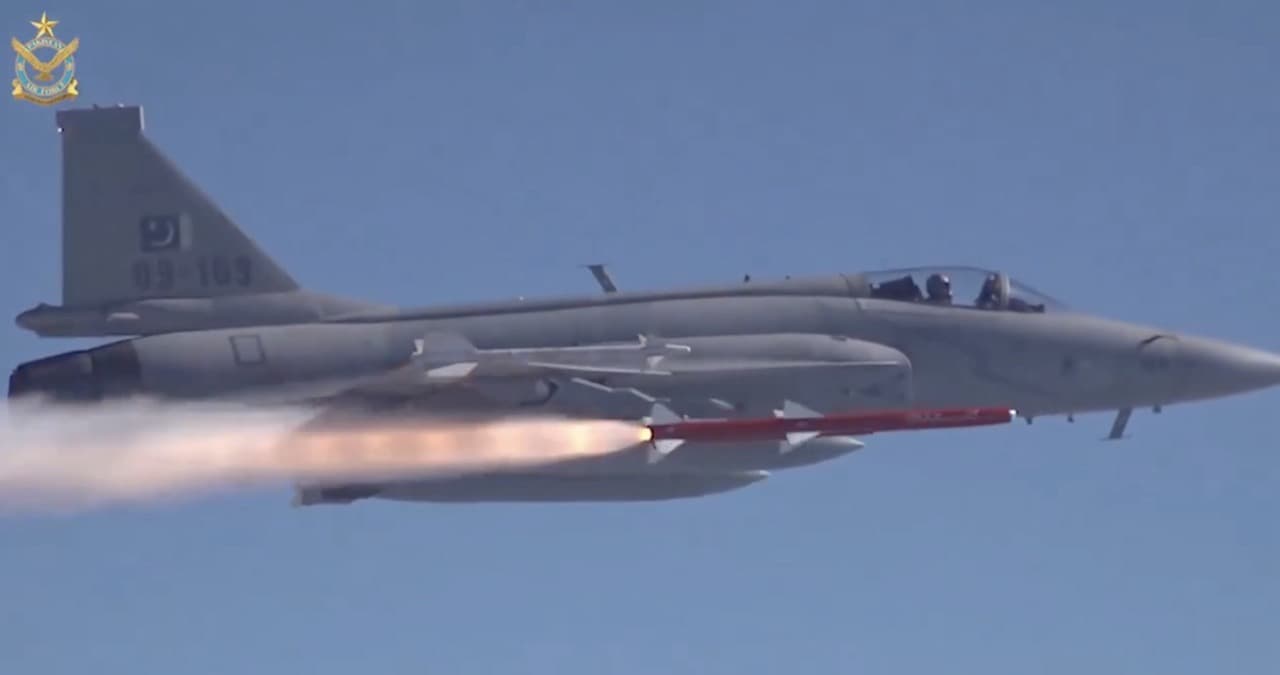
Pakistan has successfully test-fired its first indigenous beyond-visual-range air-to-air missile (BVRAAM), Fa'az, from a JF-17 Thunder fighter jet. The missile was developed jointly by the Global Industrial and Defence Solutions (GIDS) and National Engineering and Scientific Commission (NESCOM). The launch marks a strategic step for the Pakistan Air Force (PAF) in reducing dependence on foreign air-to-air weapons and equipping its combat aircraft with fully independent munitions networks.
Why it matters
- Fa'az features dual-seeker options (active radar and imaging infrared) and a modular architecture designed for both air-to-air and ground-based air defense roles (Fa'az-SL).
- Two variants are planned: Fa'az-1 with a range of approximately 100 kilometers, and Fa'az-2 with a range of 180 kilometers and speeds up to Mach 3.5.
- The test was conducted from the JF-17 platform, which forms the backbone of the PAF fleet.
The missile airframe bears similarities to China's SD-10A and incorporates a solid-fuel rocket motor and avionics with high electronic warfare protection. Pakistan has previously reported operational superiority using Chinese-origin PL-15 missiles in conflicts with India; the Fa'az program aims to sustain this capability through a domestic alternative while avoiding exposure to embargoes or usage restrictions. Integration of fifth-generation indigenous munitions onto JF-17s is viewed as the next step in this vision.
Why it matters for Turkey
For Turkey, Pakistan's progress highlights a broader trend among JF-17 operator nations to develop sovereign long-range air-to-air capabilities. As Ankara advances its own indigenous missile programs, including Gökdoğan and Bozdoğan, parallel efforts by partners such as Pakistan shape regional deterrence dynamics and influence export competition in the beyond-visual-range missile market.
Source: Tolga Özbek