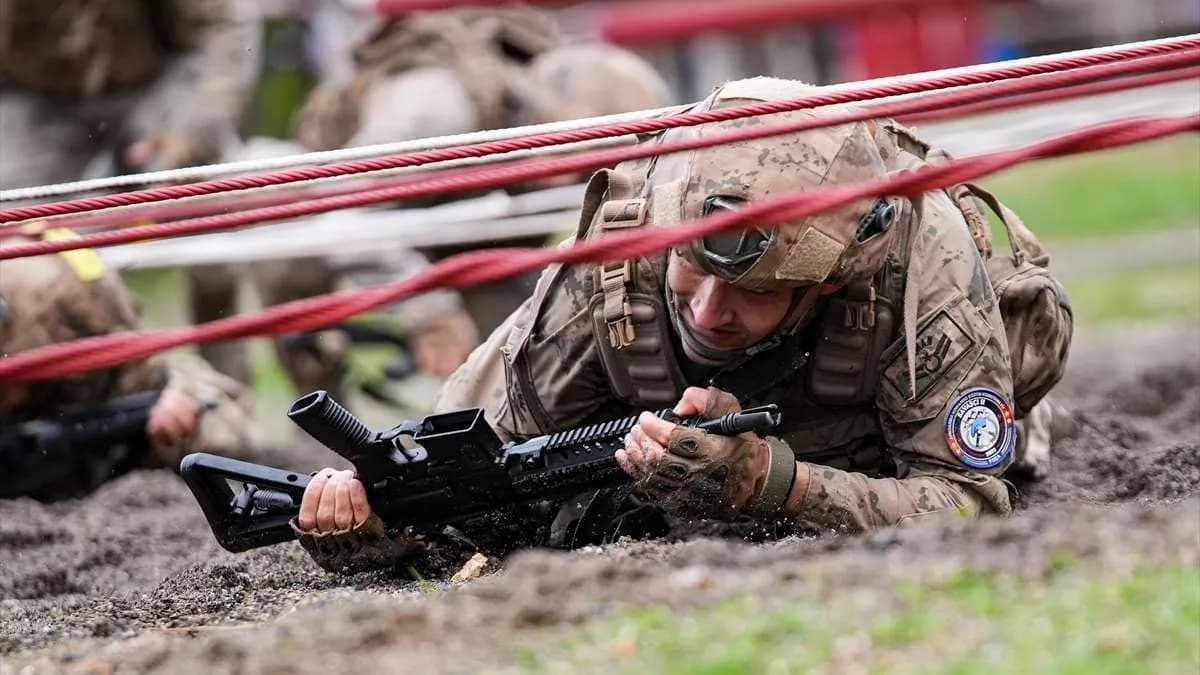
The second Warrior Competition took place at the Gendarmerie Commando Training Command in Foça, Izmir, with 630 personnel from 105 units participating. Six-person teams from Gendarmerie Special Operations, Battalion, and Special Public Order commands competed across four courses named "Fast and Furious," "Close Contact," "Major Engagement," and "Night Hunt." Scenarios included climbing, obstacle crossing, navigation, live-fire with various calibers, movement through mined terrain, and casualty evacuation. Gendarmerie Lieutenant Hasan Tanik stated that the competition blends theoretical training with field application, strengthening decision-making under stress and team coordination. The event also validated the operational performance of domestically produced weapons and ammunition used during the competition.
Why it matters
- The exercise tests Gendarmerie combat readiness under realistic field conditions, including night and day live-fire and endurance challenges.
- Using Turkish-made weapons and ammunition verifies the operational performance of domestic defense inventory.
- The competition reinforces stress-resistant decision-making and small-unit tactical coordination.
This reflects the Turkish Armed Forces' human-centric readiness approach and an integrated training doctrine with national systems, aimed at increasing operational tempo and unit resilience.
Why it matters for Turkey
The Gendarmerie General Command is a military-status law enforcement force under Turkey's Ministry of Interior, responsible for rural security, border support, and counter-terrorism. For international observers, this competition signals Ankara's priority on realistic, stress-inoculation training for its security forces and its broader push to prove domestically developed weapons and equipment in operational settings rather than only on firing ranges.
Source: Defense Here