
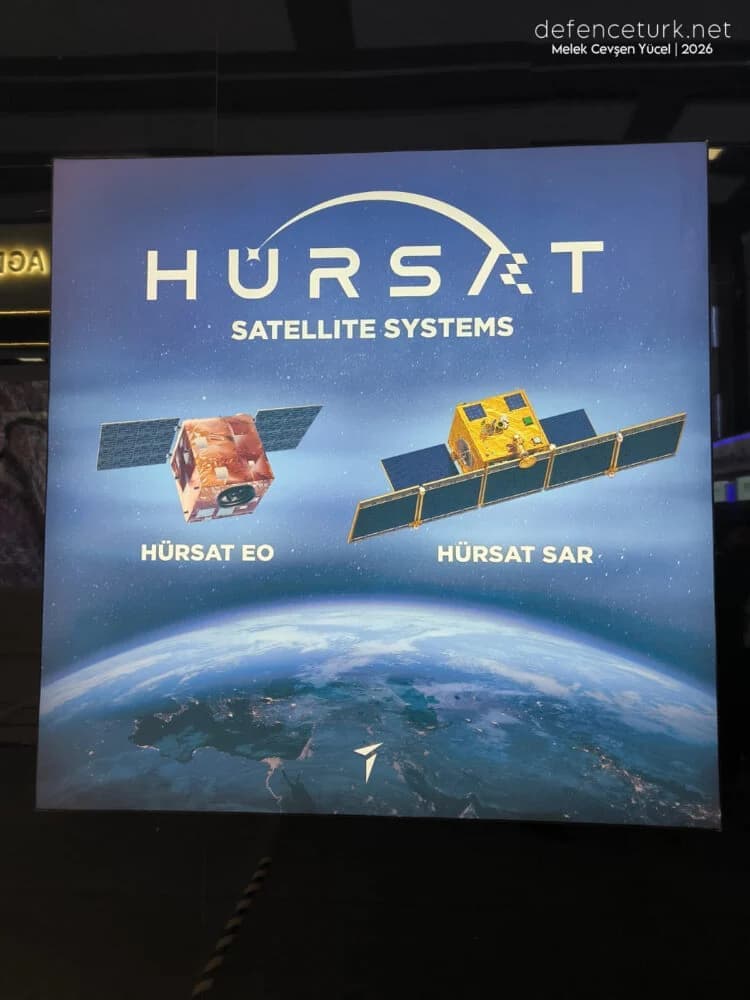
Turkish Aerospace Industries (TUSAŞ) is moving its HÜRSAT satellite family into serial production using a team-based satellite architecture. The project builds on engineering experience from Turkey’s GÖKTÜRK reconnaissance satellite program.
Why it matters
- HÜRSAT offers scalable platforms from 100 to 650 kilograms, using common subsystems and shared production infrastructure so satellites can be configured quickly for different missions instead of being designed from scratch.
- A team or constellation architecture allows the same region to be revisited more frequently and critical data to be reached much faster; development time, currently around 24 months, is expected to shrink significantly as serial production matures.
- The first satellite, HÜRSAT-1, will operate in a sun-synchronous orbit at approximately 500 kilometers altitude, delivering sub-meter imaging with 0.9-meter panchromatic and 3.6-meter multispectral resolution.
HÜRSAT-1 will collect data in panchromatic, RGB, and near-infrared bands to support civilian applications such as agriculture, environmental monitoring, disaster response, and urban planning. Satellites in the 100–500 kilogram class will perform electro-optical, synthetic aperture radar, and thermal observation missions, while the 500–650 kilogram class will focus on communications and artificial intelligence-supported data processing in orbit.
Why it matters for Turkey
This “satellite factory” vision supports Turkey’s New Space strategy by shifting away from single, heavy, long-development strategic satellites toward an agile, low-cost, sustainable ecosystem of rapidly replicable satellites that operate together and can be continuously updated. For foreign observers, it signals a maturing Turkish defense industrial base capable of series-producing space assets that strengthen both military deterrence and civilian infrastructure.
Source: Defence Turk